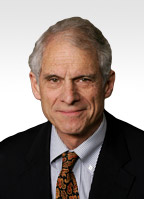
D. Montgomery Bissell, M.D.
- Professor of Medicine Department of Medicine Director Emeritus, UCSF Liver Center
Contact Information
Division of Gastroenterology
513 Parnassus Avenue, Room S-357
San Francisco, CA 94143-0358
Phone: (415) 476-2777
Fax: 415-476-0659
[email protected]
Education
Harvard College, Cambridge, MA, A.B., 1962, English
Harvard Medical School, Boston, MA, M.D., 1967, Medicine
Residencies
- Harvard Medical Service, Boston City Hospital, Residency training, 1967-70, Internal Medicine
Postdoctoral Training
- University of California, San Francisco, Research training, 1970-73, Liver Biology
Clinical Expertise
- Alcoholic Liver Disease
- Autoimmune Hepatitis
- Benign Liver Tumors
- Cirrhosis
- Fulminant Hepatic Failure
- Hepatitis B
- Hepatitis C
- Hepatocellular Carcinoma (Liver Cancer)
- Live Donor Liver Transplantation
- Liver Transplantation
- Nonalcoholic Fatty Liver Disease
- Primary Biliary Cirrhosis
- Primary Sclerosing Cholangitis
Biography
Dr. D. Montgomery Bissell is Professor of Medicine and Director Emeritus of the UCSF Liver Center, an NIH-funded consortium of 40 independently funded researchers who study the liver and its diseases. Bissell has a career-long interest in liver disease, dating to when he conducted a project on hepatocellular carcinoma in East Africa as a Harvard medical student. He then turned his attention to defining the cellular responses and molecular regulation of the scarring process known as fibrosis and cirrhosis. The latter is the most important consequence of many chronic liver diseases including inborn errors of metabolism, viral hepatitis, autoimmune states, alcohol abuse and others. It also is the setting for most cases of liver cancer.
Since 1981, Bissell has led the Rice-Liver Center Laboratory at San Francisco General Hospital, known internationally for basic research on fibrosis and defining new therapies to block fibrosis progression in patients. He is a member of several professional organizations including the American Society for Clinical Investigation and the Association of American Physicians and has served on numerous review panels for NIH, the Veterans Administration and other groups.
Awards & Honors
Research Overview
My laboratory investigates tissue remodeling in liver injury. We have been focusing recently on oval cells, which are liver progenitor cells and proliferate in several forms of liver injury. Oval cells, can be isolated and, with expansion in culture, hold promise for cell-based therapy of a variety of liver diseases. We have recently defined a member of the TNF-alpha family of cytokines that appears to be a specific growth factor for a subset of oval cells. We are interested also in mechanisms of the fibrotic response to biliary injury. We have found that TGFβ and the integrin αvβ6 have key roles.
Research & Funding
- UCSF Liver CenterSponsor: NIH/NIDDKSponsor ID: P30DK026743Funding Period:Jul 1985-May 2023Principal Investigator
- General Clinical Research CenterSponsor: NIH/NCRRSponsor ID: M01RR000083Funding Period:Oct 1974-Nov 2007Co-Investigator
- CELLULAR PATHOPHYSIOLOGY OF HEPATIC FIBROSISSponsor: NIHSponsor ID: R37DK031198Funding Period:Jul 1982-Jun 2004Principal Investigator
- REGULATION OF THE FIBRONECTIN GENE IN LIVER CELLSSponsor: NIHSponsor ID: R03TW000717Funding Period:Sep 1996-Aug 2000Principal Investigator
- MATRIX-DEGRADING PROTEINASES AND HEPATIC FIBROSISSponsor: NIHSponsor ID: R01DK039506Funding Period:Sep 1988-Aug 1991Principal Investigator
- LIVER CORE CENTERSponsor: NIHSponsor ID: P30AM026743Funding Period:Jul 1985-Jun 1990Co-Investigator
Clinical Trials
- Study ID: NCT03118674Start Date: Aug 2017Estimated Completion Date: Aug 2024Condition(s): Porphyria Cutanea Tarda, Hepatitis C
- Study ID: NCT01568554Start Date: Dec 2011Estimated Completion Date: Dec 2018Condition(s): Hereditary Coproporphyria, Acute Intermittent Porphyria, Variegate Porphyria
- Study ID: NCT01561157Start Date: Nov 2010Estimated Completion Date: Dec 2024Condition(s): Acute Porphyrias, Cutaneous Porphyrias
Publications
MOST RECENT PUBLICATIONS FROM A TOTAL OF 43
- Sardh E, Harper P, Balwani M, Stein P, Rees D, Bissell DM, Desnick R, Parker C, Phillips J, Bonkovsky HL, Vassiliou D, Penz C, Chan-Daniels A, He Q, Querbes W, Fitzgerald K, Kim JB, Garg P, Vaishnaw A, Simon AR, Anderson KE. Phase 1 Trial of an RNA Interference Therapy for Acute Intermittent Porphyria. N Engl J Med. 2019 02 07; 380(6):549-558. View in PubMed
- Wang B, Balwani M, Bonkovsky HL, Anderson KE, Bloomer JR, Bissell DM, Phillips JD, Desnick RJ. Reply. Hepatology. 2018 02; 67(2):803-804. View in PubMed
- Bissell DM, Anderson KE, Bonkovsky HL. Porphyria. N Engl J Med. 2017 11 23; 377(21):2101. View in PubMed
- Bissell DM, Anderson KE, Bonkovsky HL. Porphyria. N Engl J Med. 2017 Aug 31; 377(9):862-872. View in PubMed
- Langendonk JG, Balwani M, Anderson KE, Bonkovsky HL, Anstey AV, Bissell DM, Bloomer J, Edwards C, Neumann NJ, Parker C, Phillips JD, Lim HW, Hamzavi I, Deybach JC, Kauppinen R, Rhodes LE, Frank J, Murphy GM, Karstens FPJ, Sijbrands EJG, de Rooij FWM, Lebwohl M, Naik H, Goding CR, Wilson JHP, Desnick RJ. Afamelanotide for Erythropoietic Protoporphyria. N Engl J Med. 2015 Jul 02; 373(1):48-59. View in PubMed
- View All Publications